Showing posts with label drama. Show all posts

Thursday, June 13, 2013

Why do artistic people suffer from so much depression?

What do Ernest Hemingway, William Inge, George Reeves, Tony Scott, Virginia Woolf, Vincent Van Gogh, Johnny Ace, and Leslie Cheung have in common? They are all respected artists in their fields. Yes, but one more thing: they all have committed suicide.

In fact, suicide is extremely common among artists. Almost as common as alcohol and drug addiction and mental illness. We all "know" artists are misunderstood, tragic, and starving, only to be recognized and accepted long after death. But why?

  
Le Suicidé, a Manet, from Wikipedia


The Death of Chatteron, H. Wallis, from Wikipedia
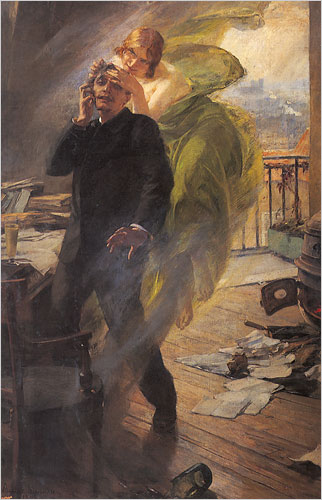
La Muse Verte, A. Maignan, from Wikipedia


Depression among creative people is one of those accepted truths. It is so ingrained in our culture that painters have painted it, singers have sung about it, and writers have written about it. Kayne West, for example, alludes to suicide and depression quite a bit in his music catalogue. He is crying for help in front of millions.

For those who do not entertain suicide ideations (at least at first), there is the ongoing problem of addiction. There are too many examples to count all of the artists who drank, snorted, injected, or inhaled themselves to death. From John Wayne to Elvis Presley to DJ Screw to Amy Winehouse.


I'm writing this post to fight some of my own demons. I get extremely depressed often. I know others who get just as depressed. I've doubted my abilities. I sometimes grow angry at God for not taking away the thoughts and pain. I've contemplated suicide, mostly during my teens. I sometimes avoid getting intimate with people for fear they might think something is wrong with me. I recognize the patterns of addiction too well, and I try to avoid alcohol and drug abuse. Food was my main addiction. But others I know have battled with drugs and alcohol. Some don't even realize they have a problem.

For me, I wondered why others did not enjoy what I thought were the individual notes in the symphony of life. I would look at a wood table and be fascinated by the beauty of the pattern, but realized I could not share this with others. "It's just a table" would be a normal response. Or maybe just the thought that I'm an eccentric. Then you realize how alone you are in the world you created for yourself:

One theory suggests that many creatively gifted individuals may suffer from depression as a result of being in environments that don't support their creativity. In the The Woman's Book of Creativity, C. Diane Ealy, PhD, writes, "Many studies have shown us that a young girl's ideas are frequently discounted by her peers and teachers. In response, she stifles her creativity.” Other experts agree that suppressed and misunderstood creativity can lead to severe neurotic and psychotic behavior, addictions, unhealthy relationships, concealment of abilities, hopelessness, and depression.


Gifted and talented people are often divergent thinkers who have unusual, original, and creative perception and elaborate fantasies. They may disagree with authority, invest in their own interests, and express unpopular views. This can present social challenges, particularly for girls and women, as a result of a cultural expectation to conform.

Gifted and talented people generally receive little acceptance for their unique selves, and may have poor self-esteem and difficulty trusting people. This situation can lead to feelings of isolation and frequent bouts of depression.

Gifted and talented adults are driven to express their inner creativity but may be hindered by self-criticism, self-doubt, and feelings of inferiority, says Mary Rocamora, who heads a school in Los Angeles for gifted and talented adults. When this happens, frustration can turn into hopelessness and depression.

--Amy Scholten, MPH "Creativity and Depression: Is there a Link?"

As artists, we do not have to accept that we will always be depressed en masse. I urge any depressed artists to talk about their feelings of self-doubt to someone you trust. Someone supportive. The stereotype of the tortured genius might actually hurt the artist community. Romantic notions about a life of pain because you are an artist are a lie. Do not accept your depression. Avoid addiction, even if you think drugs and alcohol fuel your creativity. They do not and never did. If you are thinking about suicide, talk to a professional. Suicide never solved anything and affects everyone who ever knew you. And if anyone thinks you are an eccentric, that's their problem, not yours. Be yourself.

Happy Filmmaking.

Monday, December 22, 2008

VHS R' Us

What to P.T. Anderson, Kevin Smith, and Quentin Tarantino have in common? Besides being famous filmmakers with large fan bases, but all are established filmmakers sans film degree. These directors are usually the argument against film school. However, proponents of film school argue that these directors had a once in a lifetime shot to make it, as opposed to increasing your chances by building your network. If you aspire to be like one of these directors, there is one thing you have to do: eat, sleep, and breathe cinema.

These directors are often called "VHS filmmakers" because their "film education" consisted of watching hundreds and hundreds of films similar to their interests. Ed Wood was also this kind of director (even though he may not be the best example). These directors also have high IQs and can easily processes certain techniques.

Even if you have a fancy film school degree, it wouldn't hurt to do a little more research. Here are some tips:
  • To save money, go to your local library or invest in a subscription service like Netflix.
  • Put aside some time in your day or week to watch a film undisturbed. The more distractions, the more you miss.
  • Use lists such as AFI's top 100 films, or IMDB top 250 as a guide for films you NEED to watch.
  • Even if using the above lists, keep in mind that they slant towards American filmmaking. Be on the lookout for notable foreign filmmakers and auteurs as well, such as Fellini, Goddard, Kurosawa, Bergman, Malle, and Lang.
  • Also look at films considered the "worst films ever" (not because your brother says so, but actually films universally considered bad, like Showgirls). They are good examples of what NOT to do. Usually a film's on the list because of the storyline and acting, not just poor production value or technical problems. Need help? Cheat by looking up which titles Mystery Science Theatre 3000 lampoons.
  • Take notes. Not just on the storylines and actors, but on camera angles, scenes, filmic styles, transitions, and art direction.
  • Watch movies in the same genre. Take note of any genre patterns.
  • Rewatch your favorite films. Why are they your favorite?
  • Enjoy yourself. You're watching a movie. Feel free to have popcorn, coke, and Twizzlers.

Happy Filmmaking!

Wednesday, November 5, 2008

“Smokey the Bear must be a pyromaniac”…and other crazy things people blurt out.

Originally published on my myspace page.

Today's blog is about developing good and natural sounding dialogue. Writers tend to want to be witty through their characters' dialogue and try too hard, resulting in stale, unnatural lines. The best way to learn natural dialogue is through people-watching or engaging into a conversation with someone close.

Think of these questions when writing dialogue:
  • What does your character like to talk about?
  • What events are happening in a character's life?
  • What is your character's personality?
  • Is your character cynical, witty, monotone?
  • What is your character's age, gender, creed, and race?
  • What is your character's political background?
  • What is your character's socioeconomic status?
  • What is your character's daily routine?
  • Who hangs around your character?

A popular trend nowadays is to have a character blurt out witty, but disturbing one-liners, especially in comedies. Films and television shows that follow this trend with positive results include Little Miss Sunshine, Superbad, Juno, Ugly Betty, South Park, Wedding Crashers, and Mean Girls. This trend works because people do indeed say awkward things to their friends and family members. However, it is important not to overdo this in an attempt to cover up a lack of good dialogue. Your characters must be saying something relevant to the storyline.

Dialogue follows trends of the decade. In the 1930s and 40s, when film noir and screwball comedies were popular, characters were smart, cynical, fast-talking, and pessimistic. In the late 50s to early 60s, film dialogue softened tremendously towards a melodramatic side. If you are writing about a particular period of time, especially within the last century, take note on how films portrayed their contemporaries. Because the studio system used to hire scores of writers on one project, dialogue was usually done well.

English-language Films known for their excellent dialogue:
Casablanca (1942)
It Happened One Night (1934)
Sunset Blvd (1950)
Citizen Kane (1941)
Network (1975)
Toy Story (1995)
Godfather (1972)
The Player (1992)
Office Space (1999)

English-language "classics" with cheesy, over-the-top dialogue:
Showgirls (1995)
Top Gun (1986)
Catwoman (2004)
Manos: The Hands of Fate (1966)
Gigli (2003)


Check this out, too: http://www.filmsite.org/greatfilmquotes.html


Happy Filmmaking!